
Seinfeld and the impossible memoir
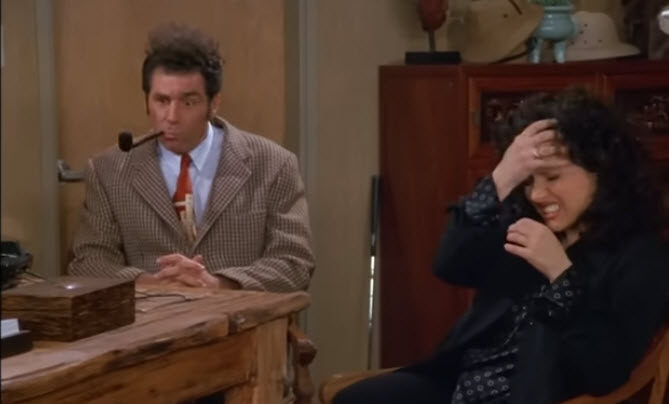
The other day, I watched an old episode of Seinfeld. For afficionados, it was the one in which Elaine agrees to ghostwrite a memoir for her boss, Mr Peterman.
There’s a five minute series of edited highlights here. It’s well worth a watch.
As a ghostwriter myself, I was intrigued. How would the excitable and over-optimistic Elaine rise to the challenge of penning her manager’s life story, while flattering him at the same time? Just as importantly, what would we learn about the inner world of the enigmatic Mr Peterman? I couldn’t wait to find out.
The project starts on a positive note when Elaine asks Peterman what exciting and exotic experiences he wants to focus on. Love affairs? Foreign adventures? But her expectations of juicy material are dashed when Peterman dismisses her suggestions. Instead, he wants his book to be about his ‘day to day life’.
Elaine is crestfallen. How is she to turn her boss’s humdrum routine into a compelling memoir that will fly off the shelves and do him proud?
In despair of finding any interesting material at all, Elaine resorts to using an incident from the quirky Kramer’s life as a substitute for Peterman’s mundane insights – with both their blessing. Soon, Peterman is ‘buying’ Kramer’s entire life story for Elaine to use, with chaotic and disastrous results . . .
So, what we can we learn about memoir material from this wonderful story? There are two that come to mind.
Know your goal for your memoir
To write a memoir that does what you want it to, you have to know what ‘want’ means in the first place.
So, what is it that you aim to achieve with it? Is it to:
- Gain a traditional publishing deal and make it a bestseller?
- Self-publish it so you can share it with family and friends?
- Make money out of selling copies of it?
- Use it to launch a speaking career or raise your profile?
- A combination of the above – or something else?
You may have noticed that the one goal I’ve not listed is ‘To tell my story’.
While it’s an understandable desire, all memoirs do that. You must decide what you want to achieve after you’ve done the telling. In other words, what kind of life you want your book to live when it’s out in the world.
To help you with this, imagine you’re a year after publication and reflecting on whether it’s been worth your while to write your memoir. What would you point to as evidence of its success (or failure)? What matters most to you?
When you know that, you’re already one step ahead of Peterman and are ready for the next step.
Know what you need to achieve your goal
If your aim is to write a book that shares your story with those who already know and love you, and you’re not concerned about selling thousands of copies to strangers, your task is simple. Just write the story you want to write and self-publish it. You have freedom to write it in any way you want.
But if you’re like many prospective authors who approach me to help them write their memoirs, you may have different ambitions. Perhaps you want to gain a traditional publishing deal or a readership far beyond your own circle and even your own country – and more.
If that’s your aim, here’s what you need to know.
A traditional publisher looks for four things in a memoir:
- An extraordinary story, preferably with a topical or otherwise significant message embedded within it
- A big-name author who already has a following
- A marketing platform that allows the author to promote it to many thousands of people
- Story-telling abilities that enable the author to spin their story into gold (without resorting to Elaine’s tactics, naturally)
Now, they might not get all four. Many non-celebrity memoirists, for instance, have published their books to great acclaim and have achieved genuine success.
But it’s fair to say that you’ll need at least two or three of those factors in place if you’re to gain the interest of a good publisher. And also of the public to whom you’ll eventually market the book.
Unfortunately, the opportunity for an unknown author with no marketing platform, who has a life story that’s interesting to those who already know them but not to those who don’t, is very slim.
However, there’s one factor I haven’t mentioned so far.
It’s luck.
There’s always a chance your story might be just the one a publisher is looking for at that moment, scratching a topical itch that’s irrestible to them. What’s more, there’s no accounting for tastes. Some memoirs have been a hit because they happened to catch the public’s imagination, and it can be hard to predict what will do that.
You never know.
So if you’re ready to roll the dice, the keyboard may be calling. With or without the help of Elaine (or Kramer), you could find yourself in the middle of a runaway success of your own.


